

waiting for :: writing through
Notes on ambient disaster.
“We line one day up after the other, day after day, as if the world did not exist, though daily it seeks us out with such violence.” —Édouard Glissant, Poetics of Relation
There is a viral photobooth that I often pass on my mid-afternoon walks. It is the kind of baffling Manhattan attraction that compels young people to spend half an hour in line. Last month, when the temperature dropped below freezing, the line still didn’t let up. As soon as one cluster of puffer-wearing brunettes departed, a new group would appear. On warm sunny weekends, when the line ballooned to egregious lengths, I’d single out a person or a couple wearing something particularly eye-catching. The goal was to finish running errands before they’d reach the front. This made-up game allowed me to derive some minor pleasure from my own productivity, as if I were any better—or any more or less insane—than those waiting in line.
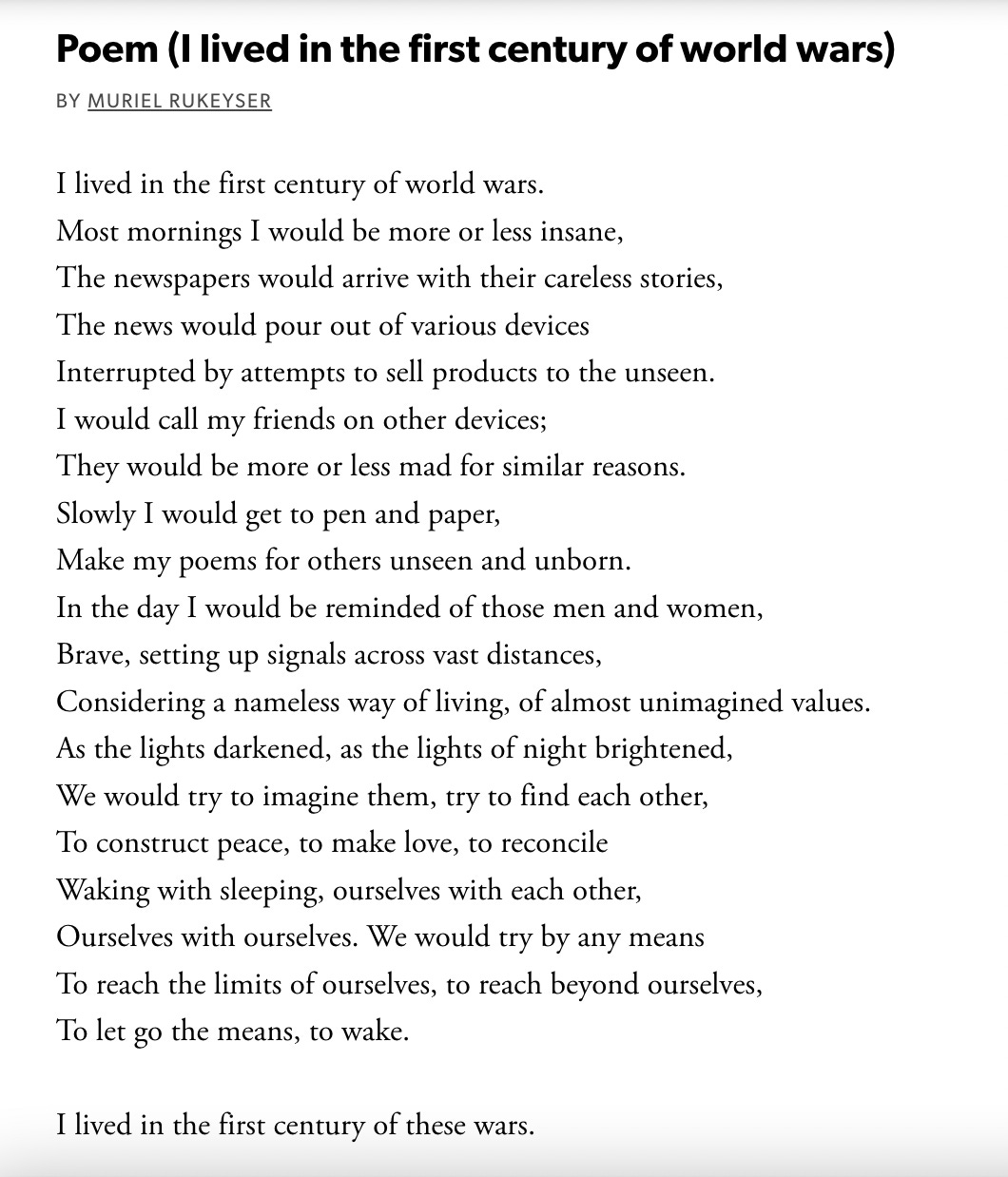
I recently came across this poem by Muriel Rukeyser, written sometime in the 1950s. Rukeyser was born in 1913, one year before the First World War, so I imagine this was written from her adult experience of the Second World War. “Poem” initially seemed straightforward, in the manner of a diary entry. But upon re-reading, I became intrigued by the temporal ambiguity introduced in the first line, and Rukeyser’s insistence on maintaining a sense of non-specificity throughout the poem, especially in lines like, “The news would pour out of various devices” and “Brave, setting up signals across vast distances.” In writing for the “unseen and unborn,” why focus on the technological or geographical particularities of one’s time?
The speaker’s “I” swiftly and briefly morphs into a “we” in the latter half. “Try” is the key verb in these lines. Rukeyser is expressing a hypothetical action (would try) instead of a realized one. Rather than a call to action, it’s a rumination on potential or past efforts. One can interpret these moves as an attempt for the poem to live beyond the era of its composition or a gesture towards universality, though it concludes on a note of unease. I find the final line, “I lived in the first century of these wars,” quite ominous, down to its placement on the page, as a suggestive transition to an unwritten stanza (or poem) on the second century of world wars. Might the return to the self, the “I” in the last line, be an indication of the collective failure “to reach the limits of ourselves, to reach beyond ourselves”? My reading, of course, is colored by the times that I am living through.
It was warmer than usual on February 28. A high of 48. I woke, made my bed, dropped off laundry and dry cleaning. I went to a coffee shop where the photobooth was visible from the window and read Eleni Stecopoulos’s Dreaming in the Fault Zone. I read the news. As I watched the queue inch forward, I thought about how I have grown accustomed to living in an ambient state of disaster; how I am primed, like the rest of New York society, to partake mindlessly in rituals of consumption that impose a sense of false orderliness upon my disordered life; how my waiting for laundry was, in a way, an actionable equivalent to waiting for a photobooth or a private equity-funded bagel. Everyone around me, those of us leisurely occupying this Lower Manhattan block, seemed equally held in a state of suspension as the news poured out of our various devices.
A few weeks later, I encountered a passage from Glissant in Poetics of Relation, a text that I still admittedly have trouble grasping, but this sentence (after many pages of half-understood sentences) presented a unique catharsis: “Common sense tells us that the world through which we move is so profoundly disturbed (most would call it crazy) and has such direct repercussions on each one of us that some are obliged to exist in absolute misery and others in a sort of generalized suspension.”
Generalized suspension. I think of H.D. and her brief stint in Vienna, where she relocated in 1933 from England to undergo psychoanalysis with Freud. “Already in Vienna, the shadows were lengthening or the tide was rising. The signs of grim coming events, however, manifested in a curious fashion,” she writes in Tribute to Freud of the “confetti-like … gilded paper swastikas” that were strewn on the streets, the “death-head chalk-marks” down Bergasse, the rifles stacked neatly in “bivouac formations at the street corners.”
I think of Jean Rhys’s “Till September Petronella,” which I read after encountering Aria Aber’s excellent newsletter on the story. Set between London and the English countryside, the story takes place on the day that Austria-Hungary declared war on Serbia, which set in motion a chain of events leading to the First World War. We only know this because the protagonist, a depressed chorus girl named Petronella, finds herself in a pub with two calendars: “One said January 9th, but the other was right—July 28th, 1914.” Nothing in the plot is explicitly political. Still, there is something temporally disorienting about the story, enacted through Rhys’s ennui-laden narration. The title, then, becomes a foreboding nod to the impossibility of September—the bourgeoise run-of-the-mill September that Petronella and those in her social milieu envision to be in their future. In one exchange, she tells a potential suitor that she wants him to bring her “a gold bracelet with blue stones in it” before he departs, saying: “All right, I’ll see you in September, Petronella.” The story ends shortly thereafter, and our knowledge of what is to come lends the characters’ fleeting interactions an added sense of melancholy. September will come and the world will be different.
In February, I came across a 2004 exchange between the poets Leslie Scalapino and Judith Goldman, which felt so timely in its concerns with the function of language in a violent, deteriorating world.
To quote Goldman (italics my own), “I suppose that any moment in history has been inhabited, endured by people feeling their time to be epochal, or even apocalyptic. I, too, cannot help but exceptionalize this era, my own and exceptional for me (trivially or naively) in that I live through it in the first phases of my intellectual adulthood.” Reading Rukeyser and H.D. and Rhys is a reminder that this moment, however rotten and monstrous, is not exceptional. How to face the day with that understanding?
One of the most moving poems I’ve read this year is Scalapino’s way. It’s a testament of her poetic heft that I am struggling to describe it or even liken it to any other literary work. Charles Bernstein likened Scalapino’s work to a “new and thrilling poetic software, allowing for a phenomenological unique experience, something like a 3- or 4-D poem … The present time of the work is intensified by her echoes (overlapping waves of phrases) of what just happened and what is about to happen, so the present is expanded into a temporally multi-dimensional space.”
She is often associated with the L=A=N=G=U=A=G=E poets, an aesthetic “school” that sought to resist “traditional” poetic conventions, focusing instead on the materiality of language—how the meaning of a word or a line or a poem is not fixed, but wholly dependent on context and readerly interpretation. Put more simply, these poets were interested in subverting then-mainstream ideas of what a poem, or even a poetic line, should be. I don’t think Scalapino would agree with this characterization, as it pertains to her work. She was staunchly committed to reality and realism, and believed that her poems were real events in their own right.
way demonstrates not just a way of seeing, but a multifaceted and exacting engagement with what Scalapino encountered on city streets: homeless people, car accidents, muggings, birds, construction workers, crowds. It opens with a dense epigraph by quantum theorist David Bohm, which claims: “We admit also that nevertheless there still exists an absolute, unique, and objective reality.” I feel that I cannot do justice to way aside from citing sections of it outright, in part because the poem resists the kind of narrative and emotional linearity that is conducive to synopsis. Yet in reading it, I felt myself changing on a cellular level, incrementally, stanza by stanza.
I couldn’t quite articulate the effect way had on me until I read Scalapino’s letter to Goldman (which prompted the above response) on how one writes in relation to, or in tandem with, current events. Scalapino is aware that writing is a conceptual act, which is separate from the sphere of political-social action. However, in acknowledging this separation between (conceptual) act and (social) action, she believes that poets might be able to write towards action.
Scalapino argues that (and this is my interpretation, consider it with a grain of salt) by making language an event, writing can not only address the world but exist within it with a comparable urgency, alongside the political and social crises that are unfolding. She resists descriptive writing because, for her, it cedes authority to events that have already occurred, positioning the writer as secondary to them rather than co-present. Instead, she seems to propose that writing can generate its own present-tense reality. In this sense, the “ordinary” small action carries its own weight in reality as events that are devastating.
What I find most compelling about Scalapino’s approach is that it attempts to undo hierarchy. She writes, “I am trying to divest hierarchy-of-actions [as it] effectively voids people’s lived occurrences,” relegating individual actions to something inconsequential or invisible when compared to large-scale historical events. By flattening this hierarchy, she seems to insist that personal, immediate experience is not outside of history but constitutive of it. I’m not sure I fully grasp what she’s getting at, but it feels like she’s trying to address the disjunction the self experiences within larger political or systemic events. Writing, then, becomes a way of producing an event rather than reflecting one—a means of co-existing with history in real time, a reprieve from the state of generalized suspension.
At AWP earlier this month, I moderated a panel on “political but not political” novels, featuring Kevin Nguyen, Karissa Chen, Alejandro Varela, and Jon Hickey. We spoke about the limits of the novel as a political medium, and how a writer’s political intentions might run up against the demands of narrative, character development, and form. The panelists were all very smart and funny, and I felt sufficiently under-qualified for the task at hand. Someone asked a question about Ayn Rand, and some audience members spoke about their struggles with being “too didactic.” The conversation ended up becoming very craft-focused. I felt very much like a non-novelist in that moment. In any case, I think contemporary poetry tends to reward didacticism, while deeming a poet like Scalapino “too abstract.” That night, I went back to my hotel room and re-read the fourth movement of way, which concludes:
that
—existing
in a state of mind
when that’s a
senseless point
Thank you for reading VAGUE BLUE! As always, the newsletter remains an experimental space for me to free-associate on art, literature, media, and theory that I have recently encountered and enjoyed. I am indebted to Rachel Mikita for reading the initial email that prompted my analysis of Leslie Scalapino’s way.
Recent work:
I interviewed the Polish conceptual artist Agnieszka Kurant on her (now-closed) exhibit at Marian Goodman. I was especially interested in Kurant’s conceptual engagements with language: One video piece, Phantomatics (2026), was made in collaboration with a computational linguist. Kurant generated a hundred “phantom” languages voiced by synthetic speakers, presented as disembodied speech alongside subtitles on a colored screen. (Ocula Magazine)
I wrote about Sasha Stiles’ AI-generated A Living Poem, which was on display for nearly six months in MoMA’s lobby. An emerging interest of mine is how our relationship to and use of language is changing, due to different kinds of technological interventions. (Brooklyn Rail)